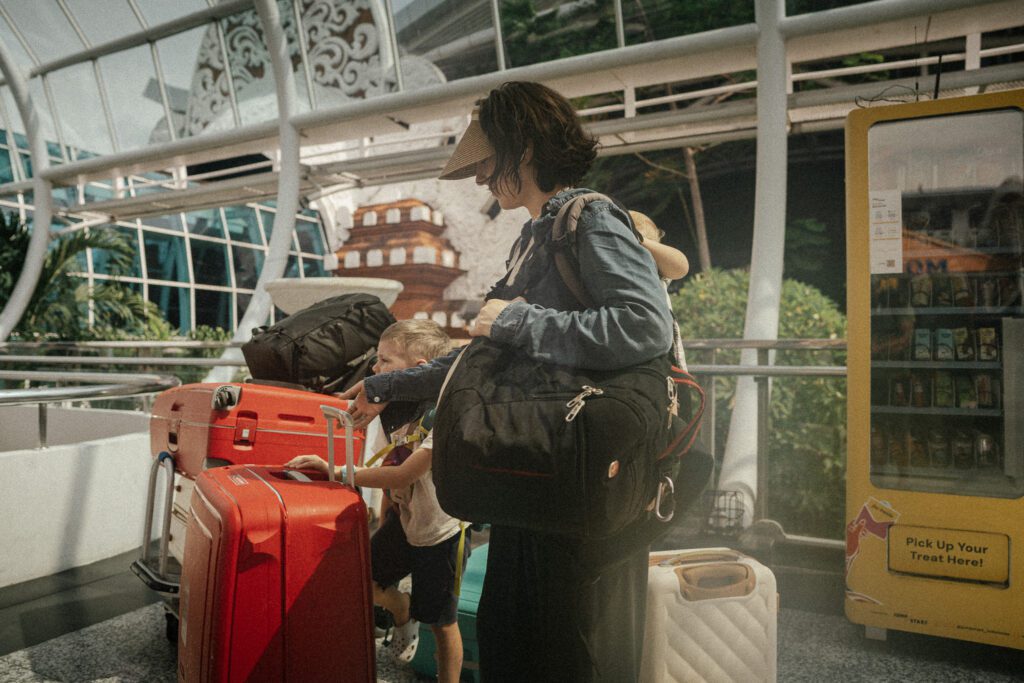
We want to tell you it’s all sunsets and spontaneous adventures. We really do. But three kids under six have a way of making sure the truth comes out eventually – usually in the middle of a busy airport, or at 2am in a hot apartment, or when someone is asking for the snack that’s still in the bag that’s still in the overhead locker.
This post is not a highlight reel. It’s not a sales pitch for the lifestyle. It’s the conversation we would have wanted to have with a family who’d actually done it before we left – the real parts, the hard parts, the parts that surprised us, and the parts that made everything feel completely right.
If you’re considering this life, this is the post that will either confirm you’re ready or save you from a very expensive mistake. Either way, we hope it’s useful.
The Honest Truth Travelling Full-Time With Kids
Let’s start here, because every travel family blog eventually gets to the hard parts and puts them at the end. We’re putting them first, because if you’re considering this life you deserve to know what you’re actually signing up for.
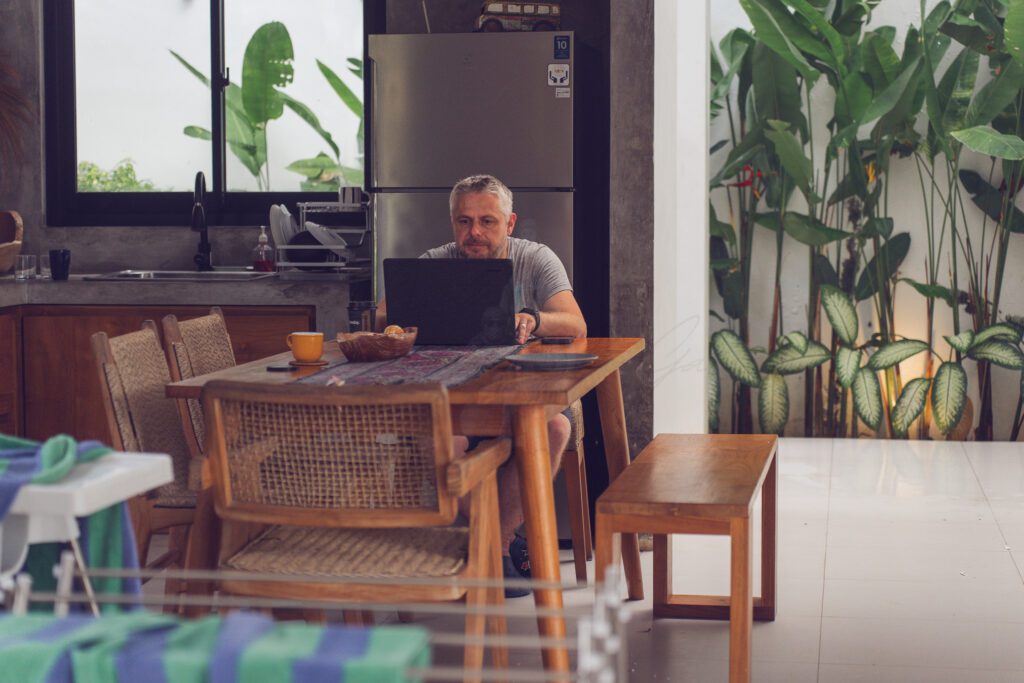
The single hardest thing for us is work-life balance. Not in the abstract sense that it’s difficult to find time for yourself – but in the very specific sense of trying to build a real business while also being the full-time primary carers of three children under six, with no external childcare, in places that are constantly new. Setting a routine where the day doesn’t just take over – where you manage to be productive at work AND present with the kids – is something we have to actively fight for in every new location. It does not happen by default.
Logistics fatigue is real. Finding accommodation, sourcing plant-based food, figuring out local transport, knowing where to take a sick child, setting up internet that actually works – every time you move, you’re doing all of that from scratch. You get better at it. But it never disappears entirely.
Missing extended family is an emotional one. The grandparents. The aunts and uncles. The people who love your kids and who your kids love. That gap doesn’t close with video calls. It’s real, and the kids feel it, and some weeks it feels more present than others.
And burnout is real – specifically for families who move too fast. Every travel family blog will tell you the same thing: slow travel is the key. When we move every few days, the toll is genuinely heavy. When we stay somewhere for a month or more, everything changes. We find our rhythm, the kids settle, and we can actually live somewhere instead of constantly passing through.
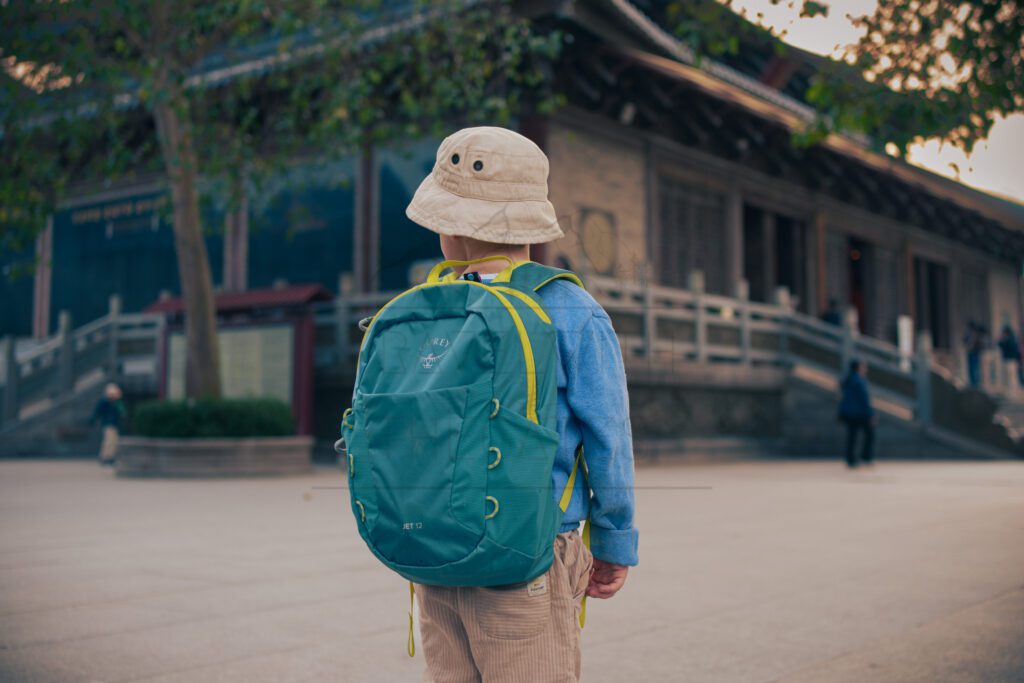
The biggest surprise was how well the kids adapted. Better than us, honestly. Children are present in a way that adults have to work very hard to be. They don’t carry the same weight of what they’ve left behind or worry about what comes next. They just live where they are. Watching that has been one of the most useful lessons of this whole experience.
The simplicity that comes with less stuff was also unexpected. We own very little now. We move what fits in our bags. Although it’s not always easy,to not buy something we had our eyes on. We humans are creatures of habit,and living the western life can easily make that habit collecting unnecessary things around you.
The mental load of owning things – maintaining them, storing them, insuring them, thinking about them – is gone. That is genuinely freeing in a way that’s hard to describe before you’ve experienced it. You don’t realise how much objects occupy your mind until you don’t have them anymore.
What we didn’t expect: the loneliness. Not all the time,but slowly starting to feel that you crave something. When you don’t have a community around you, when you’re the only faces in a neighbourhood who don’t know where anything is, when your closest friends are on the other side of the world and the time difference makes spontaneous calls rare – that can be isolating. Building community intentionally, finding other worldschooling,creative families online and in person, staying in places long enough to actually connect with people – this is something we’ve had to actively work at, and it matters. Good news is that you can change this if you want to.
Also: the kids and the flights. The flights while they’re young and not yet used to travelling, when the sleep is not timed well, when you cannot really tell a toddler to sit still for four(teen) hours – that is genuinely the hardest part of the physical logistics of this life. It gets considerably easier as they get older and more experienced with it. But the early flights are a thing, and anyone who tells you otherwise is either flying business class or lying.
And the work. Not the work itself – but the specific challenge of building a real business while also being the only childcare your three under-six children have available to them at any given moment. There is no nursery to drop them at while you finish a client project. There is no ‘quick hour’ at the office while someone else does the afternoon. The integration of work and family life is total. That demands a kind of creative scheduling and boundary-setting that we are still, honestly, figuring out. There is a ‘but…but we wouldn’t have it any other way.
This is the question everyone asks first. ‘But what about the children?’ – as if taking them somewhere that isn’t a beige semi-detached in a suburb is an act of recklessness.
Here is what we actually see. Our children are learning about new cultures, adapting to new environments, picking up words from languages around them, understanding that the world is enormous and endlessly interesting. Apart from all the things that are obvious – the travel, the experiences, the places – they are learning so much about how to build something meaningful. They see us working. They see the connection between effort and results. They see what it looks like when two people refuse to give up. And they actually learn a lot about themselves.
We are learning together. All of us. New things every single day. That is not an Instagram caption – it is genuinely what this feels like from the inside.
The socialization question. This is always the first one people go to. ‘But how will they socialise?’ Honestly? If you look at the reality of most kids in school – how social are they, really? Our kids make friends everywhere we go. Good friends. Friends who could become long-term connections. And they do it without the pressure of a social hierarchy that was never of their choosing. They learn to connect with people quickly and genuinely. We think that’s a skill, not a deficit.
The bullying at school they’re missing out on? We’re not too worried about that one. Obvious joke – but also, not entirely.
They miss their family from back ‘home’. That’s real and we say it honestly. They get a lot of stimulation, they’ve learned to love travel days, they’ve developed discipline and adaptability – but they miss their grandparents. That is the one thing they would point to if you asked them what’s hard. And we don’t pretend otherwise.
This is one we need to address directly, because it comes up every time. ‘Won’t they miss out?’ The assumption underneath this question is that a conventional school experience and a fixed home are what’s best for children by default, and that anything different is a deficit.
Here is what our kids are not missing out on: learning to sit still in a classroom while someone teaches a standardised curriculum designed for the average of thirty different children. Social hierarchies that are determined by geography and parental choice rather than genuine compatibility. The particular kind of low-level anxiety that comes from being in an environment where you have no control over who you spend six hours a day with.
What they ARE getting: languages – words picked up from every country we pass through. Cultural literacy – an actual, lived understanding that the world is not one thing. A relationship with their parents that is built on genuine shared time, not the leftover moments at the end of everyone’s exhausting day. And a sense that the world is something you can engage with, move through, and understand – not something that happens to you.
The research supports what we see with our own eyes. Children who travel extensively develop stronger adaptability, cultural empathy, and language acquisition than their peers. Over 60,000 families worldwide are now worldschooling – which suggests this isn’t a fringe experiment but a movement of families who have done the calculation and come to the same conclusion.
Worldschooling with very young children is its own thing. Our kids are under six – they’re not following a formal curriculum. They’re learning by doing, by watching, by asking questions that the world answers in real time. That feels right for where they are developmentally. As they get older, the approach will evolve. But right now the world is the classroom and we have no complaints about the teaching quality.
Plant-based food in every new place.
Yes. We eat this way, because after years of research and study we find optimal health and longevity can be achieved by this. At the same time,i also learned that forcing it to anyone will do no good,so i adapted with my approach and even softened it towards ourselves during our travels when it comes to traditional local cuisines and dishes.
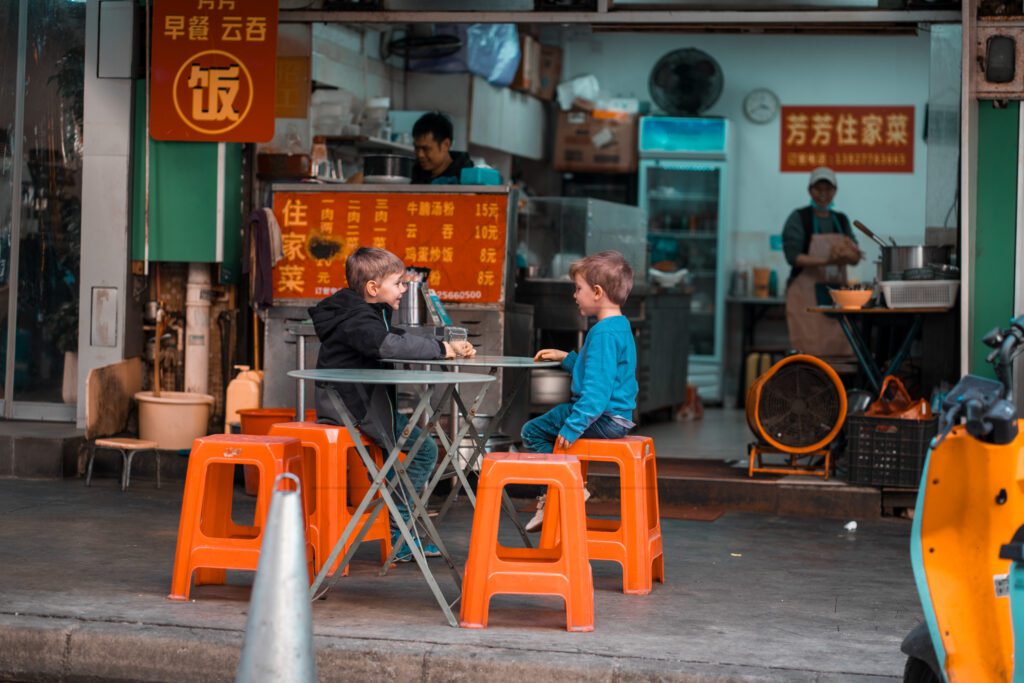
This is logistics that most travel families don’t have to think about. We do. Every new city means finding the local market, identifying which restaurants have options, learning to read a menu in a language we don’t speak. We’ve gotten very good at it. We carry dietary cards in the local language. We order the main and add our own vegetables and fruit on the side. We make it work – but it takes effort that other families don’t have to expend.
Managing illness on the road. Kids get sick. Adults toe gets broken (coming from experience haha).One of the best things you can do i to find the best possible travel health insurance for you before setting sail on your adventure.
We have chosen this as our travel health insurance. Having that in place means we can take a sick child to a doctor without the added stress of wondering what it’s going to cost,or not hesitating when you want to find out if your big toe is broken,because your child has fallen on it while standing on a solid wood table(haha).
That peace of mind is worth every penny.
Meltdowns. Because someone will ask. Toddler meltdowns do not care that you’re in a stunning temple or a busy market or an airport queue. They happen. Here’s what we’ve found works: we’ve long since stopped caring what other people think(and i phrased it lightly,because i have my opinion on that) – that worry is a luxury we left behind somewhere around kid number two. What actually helps is understanding what’s causing the meltdown. Usually it’s too much incoming noise and crowd stimulation, or something’s off with how they’re feeling. We get down to their level. We talk. We do breathing exercises. We find something to redirect their attention toward. Healthy diet with minimal sugar helps regulate their emotional states more than anything else we’ve tried. And we keep moving.
The decision fatigue of constantly setting up a new home. Every move means learning where everything is again. New supermarket. New pharmacy. New routine. It gets faster with practice. But it never fully goes away.
The time.
This is the one that compounds in a way you can’t fully anticipate before you’re in it. We are present in our children’s days in a way that was simply not possible in the life we left behind. We see them grow. We learn alongside them. We are not passing them between school drop-off and after-school club and bedtime with barely a real conversation in between. We are there. And being there – genuinely, consistently there – is the thing nothing else can replace.
The way they’ve developed.
This is probably the one we want to talk about most when people ask. Our children are adaptable. Curious. Unafraid of new things. Interested in people who are different from them, in food they’ve never seen, in languages they can’t speak but try to imitate anyway. They learn to love travel days. They have developed a discipline and a groundedness that surprises us. That is the kind of person we want to raise – and travel is doing more of that work than anything we could have deliberately designed.
The kids also learn things about building something meaningful that no school could teach them. They see us working. They understand, at whatever level is appropriate for their age, that what we do matters and that it takes real effort. They are growing up understanding that you can design your life rather than just accept the one the system hands you. That feels like a genuinely valuable education.
The moments you can’t plan.
A morning where everything goes right and you’re somewhere extraordinary and the kids are happy and everyone is quiet for a moment and you think: this. This is it. When you accidentally find a place in the midst of the green mountains where the sound of the stream is the only thing that hits your ears first. Where you feel like you are on another earth with no other people around you,the universe was gifting this to you,
This is exactly why we left. Those moments are not every day. Some days are logistics and meltdowns and patchy Wi-Fi and everyone wanting snacks at the same moment. But those other moments exist too. And they are worth everything.
Is it selfish to travel full time with kids?
We get asked some version of this too – sometimes directly, sometimes implied. Our answer: it would be more selfish not to. Staying in your comfort zone because of your children is not protecting them. It’s limiting them. They should be the reason you do this, not the reason why not. The world is larger than any of us. Show it to them while they still want to see it with you.
Our only regret?
Not starting sooner. Not laying the foundation sooner. Every year we spent in the old life was a year we could have been building this one. We can’t get those years back. But we’re making the most of every single one we have now.
Yes. Seeing them adjust, take on new responsibilities, learn about new cultures and languages, and spend time together as a family in extraordinary places – yes. A thousand times. But most of all: we are learning together. All of us. Still finding new things every day. That is worth more than anything a fixed postcode could have given us.
The honest answer to ‘do you regret it?’ – not starting sooner. Not laying the foundation sooner. That’s our only regret. The rest of it – even the hard parts, even the tired nights, even the logistics headaches – we wouldn’t trade.
Who this life works for: families who are genuinely curious, who can handle uncertainty, who are willing to build as they go, and who understand that the hard parts are part of the deal. This is not a holiday. It is a different kind of life. It requires more than a holiday does. But it also gives back more.
Who should wait: families without a real income plan in place. The lifestyle needs financial structure or it becomes survival mode – which is no good for anyone, least of all the kids.
If you’re at the beginning of thinking about all of this, start with How We Became a Full-Time Travel Family With Three Kids-that’s the story of how we got from there to here. And if the money question is where you’re stuck, read How We Afford Full-Time Travel as a Family next. That’s where the real numbers live.